What are your songs about and how do you see the band's concept in general?
The band's concept is reflected in the transformation of personal and life experiences transformed into the form of deep metaphysical analysis reflected in our music, lyrics and visual images. Disillumination's lyrics have always been characterized by an extremely pronounced degree of introspection and a deep degree of knowledge of one's inner self. It is worth mentioning that the texts are also devoted to the problems of reflection and awareness, overcoming all kinds of difficulties, grinding forms of perception, adaptation and transformation.
Tell us about the recording and mixing of the album «Into the Darkness of the Eternal Word»
In addition to the mixing process, I would like to mention the recording process first. Traditionally, we write exclusively live string sound according to the «amplifier with cabinet» scheme and sound recording on a microphone. Mastering and mixing did not cause any difficulties and withstood literally two or three iterations before the release. Also on the latest release («Ex Mundi Ad Nihil — Gnosis of the Unbeing», split with Temple of Nihil and Angr, 2023. — Editor's note) we used sampling.
I would like to point out that each instrument was recorded in different studios in Europe and compiled by a separate engineer. Thus, it was recorded in four studios, and one of them was implemented practically in the «field» conditions. However, everything was recorded live.
Did you have any conflicts during recording: with each other or with the sound engineer?
For the most part, each recording runs smoothly, based on agreements, but the few moments of tension and misunderstanding are quite natural to the creative process and require a delicate approach to their resolution from all participants in the recording. As the author of the project, I try to be flexible in accepting suggestions for improving the available material and expect the same from the team members.
Who painted the covers for your albums? They reflect the content well.
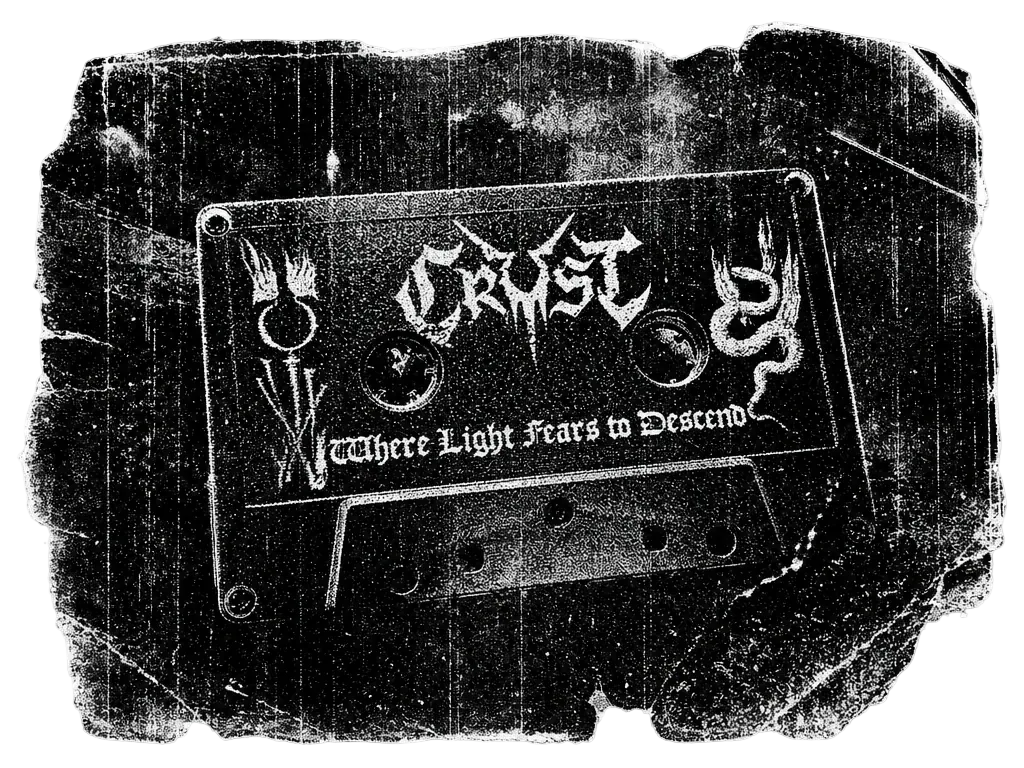
«Into the Darkness of the Eternal Word», 2021 — the cover was drawn by Ivan Stan. «Ex Mundi Ad Nihil — Gnosis of the Unbeing», 2023 — Artem Grigoriev. Indonesian artist Bagus Rio designed the sigil.
Have you ever had moments of self-doubt, and how did you overcome them?
The so-called «impostor syndrome» haunts any creative person, as he should never be completely satisfied with the results of his labors. But it is precisely on this feeling that some progress is being built both in writing and in the methods of implementing the plan.
«The so-called «impostor syndrome» haunts any creative person — he should never be completely satisfied with the results of his labors.»
— Disillumination
Which albums or bands have had the greatest impact on your work?
Of the bands and albums, I can single out Ruins of Beverast — «The Thule Grimoires», «Exuvia»; Dødheimsgard — «Satanic Art», «666 International», «A Umbra Omega», «Black Medium Current»; Aeternus — «Philosopher»; Slidhr — «White Hart!»; Portal — «Vexovoid».
What can we expect from the band in 2025?
New concerts, recording of a new album and more are what we are announcing in the near future.
What do you like about old-school metal?
Boris (guitar, vocals): I like its originality. Back then, everyone had their own face; for example, it's very difficult to confuse Bathory and Celtic Frost. Bands of that time, it seems to me, were not afraid to experiment and promote their sound, and sometimes even radically change their ideas and aesthetics.
Egor (bass guitar, vocals): The sound and musical thinking of the performers. At school, I listened to a lot of metal from the 80s and 90s. Extreme metal genres were immersed in a separate world. Old school seemed closer to me then than the modern metal of the late noughties, which absorbed the influence of hardcore. Now old-school metal rightfully occupies an important place in my understanding of the development of metal over the decades.
Igor (drums): Regarding old school, the most important thing is an intensive creative search. The bands seemed to feel that they were moving to the forefront in the development of their style. Turn on the first Entombed album, and it's like fucking evil is breathing in your ears. They were still actively developing. Listening to the discography from the first album and being surprised by the frenzied growth of ideas for the next releases, it feels like the band wasn't wasting their time. The visual component was also strong: metal set the aesthetics so that patches in denim vests appeared already in Russian schools and vocational schools, in times without the Internet and before MTV.
Which metal pieces of the 90s will not lose their relevance in 2025?
Boris: The canons invented in classic genres such as death and black are still relevant and have passed the test of time. I don't think these chips will lose their relevance in 2025.
Egor: Extremity. Perhaps it was in the 90s that metal reached its limits: low build, vocals, high tempos with all the inherent rhythmic patterns, broken dimensions — everything that the genre had developed by the 90s remained relevant in the 00s and will remain so.
Igor: The tone of the Boss HM-2 guitar pedal is always relevant; everything else is perishable.
What would you change in the music industry if you could do that?
Boris: I would change the pipelining. Modern music, especially mainstream music, has become even more «fast food» than before. I want to find and hear something original; maybe I'm just fed up.
Egor: I wouldn't have changed anything. The industry is developing according to market laws; you should not interfere with it.
Igor: Music is one of the reflections of society. I'm specifically interested in punk culture — it's the most interesting phenomenon of popular culture. The principles of musicians' existence in the context of the industry persist to this day. At some point, a lot of musicians earned money not from selling records, but from tours. It still works now, even in a niche like metal punk. My friends remained «positive» after the tour, despite the fact that they were underground and faced various difficulties during the tour. I believe that profitable tours can be made into a stable scheme. The main thing in the early stages is the love of DIY.
Igor: What can be changed? The prosperity of punk requires a fairly high standard of living in the country; otherwise, it is necessary to be freegan (from English free and vegan: an ideology that denies consumerism. Freegans can literally pick up expired groceries from store trash cans. — Editor's note), there's a squat and tools messing up somewhere, isn't there? Although I'm joking, I suggest you think about it a bit. The country needs to «get fat» so that punks can fuck themselves usefully and produce hardcore that is sharp in every sense. If the standard of living is higher, then the industry around punk will form by itself — there will be an audience, promoters and venues.
What difficulties do new groups face today compared to previous years?
Boris: The need to constantly be in the information field. Today it has become important to post a lot of content; in such an information turmoil, the main thing is not to forget that you are making music.
Egor: It depends on what period we take for comparison. If we start with the 90s, then we have to talk about what «difficulties» new groups face. Technology is evolving; sound recording is more accessible today than ever. At the same time, information connectivity has grown; it would seem that this should have made it easier to spread their creativity, but we see the overcrowding of the information space with releases. Recordings that could only be obtained by a miracle before are now full of pages from any streaming services. Therefore, I will answer the question this way: now it is difficult not so much to promote your release, but to do it on a larger scale than other teams.
Igor: The information noise has increased wildly; now living in a city means facing an information flood. The competition between the groups is higher than before. As it is, new difficulties are well-forgotten old problems; artists have definitely reached the next level of difficulty in finding themselves.
What does it feel like to be a part of the music scene?
Boris: In my opinion, the most interesting thing is the opportunity to listen to a lot of new bands and meet a lot of interesting people. Every day is about making new acquaintances and sharing valuable experiences.
Egor: Over the years, it has become natural for me; but I realize that this is just a 14-year-old kid's dream come true.
Igor: It depends in what role and at what level. In the underground, the hardest trials for musicians are tours. However, recording in the studio is almost as difficult for me personally. I am grateful to sound engineer Misha Kurochkin for helping us to do everything efficiently in conditions of limited funds. Do not forget about sound engineers, organizers, lighting technicians, photographers and cameramen — they are also part of the scene. Many of these guys genuinely love music; they support the artists with their smiles. You look into their eyes and you realize: with such people on stage, we will break through.
What qualities are necessary for a musician to have a successful career?
Boris: The most important thing is to sincerely love your job; any skills can be acquired.
Egor: The same qualities are important when building any other career: the will to develop your abilities and talents; perseverance; diligence; but luck is also important.
Igor: Speaking for the drummers, let's look at the current Korn and Slipknot drummers as an example of a successful career — they are technical and «stable» musicians with developed flexible skills and a kind disposition. For a successful career, you need to learn how to communicate, improve your playing technique, rebuild your sound, study equipment and instruments; you should also keep an eye on musical innovations and listen to music of different genres and eras. I don't do it myself because of laziness, lack of organization, and lack of attention. I would like to mention the R'n'B and Gospel universes separately: as far as I can see, the artists there are focused on performance technique and sound; they are devoted to their faith and their community, which feeds them very well — this undoubtedly helps their success.
How do you talk about your band to your friends?
Boris: Involved metal-punk.
Egor: I don't set myself the task of showing the band to friends who hardly listen to such genres; if a person shows interest, he will definitely listen to himself.
Igor: Something like «backpunk threesome, I'm the prettiest», etc.
What is your favorite thing about Disbound?
Boris: The atmosphere in the group: every rehearsal is a thrill; it's cool to understand each other at a glance during rehearsals — new ideas are realized quite quickly.
Egor: Working in a group is important first of all: the lack of stuffiness between the participants is very important to us.
Igor: I love the combination of different styles in the work of the group; we combine different genres of art to the extent that our horizons allow.
What are your plans for 2025?
Boris: To compose new things and actively perform; we will push the boundaries of our sound and look for new ideas.
Egor: Carbon monoxide and rock'n'roll! It will be difficult for the band to beat the previous year in this indicator; after all, there was a tour! But we will try very hard!
Igor: To roll out an album (at least two), arrange our media resources and establish concert activities.